 Cape Town City Guide
Load Shedding, Water & SIMs in Cape Town
Load shedding — Cape Town edition — is the question visitors researched obsessively in 2023 and mostly do not need to fear in 2026 — but "mostly" deserves its numbers, and the same page should settle the other two infrastructure worries that travel with it: the water (Day Zero made global headlines in 2018) and the SIM card (South Africa's registration law catches arrivals off guard). The short versions, each unpacked below with its official source: Eskom, the national utility, marked 300 consecutive days without national load shedding on 12 March 2026, and when cuts do return they generally last about two and a half hours per block; Cape Town specifically sits behind its own 180 MW hydro buffer at Steenbras, which the city uses to shield its customers from up to two stages of national cuts where possible — the only major South African city with that cushion. The taps: Cape Town's water is officially tested, treated and safe to drink, at 99.0–99.6% compliance with the national standard, and the dams that nearly ran dry in 2018 never actually shut the taps. The phone: every South African SIM legally requires RICA registration with your passport and proof of where you are staying, which is five minutes at an airport counter or zero minutes with a travel eSIM bought before you fly. All figures read in Q3 2026; the grid is the one item on the Cape Town city guide we re-check quarterly by policy, because it can move.
Quick answer Grid mostly quiet, city has its own buffer, water safe, SIM needs paperwork
As of in Q3 2026 there is effectively nothing for a visitor to plan around: Eskom recorded 300 consecutive days without national load shedding by 12 March 2026, and even when cuts return, Cape Town's own 180 MW Steenbras hydro scheme shields city customers from up to two stages of them where possible — meaning the city often keeps its lights on while the rest of the country rotates. Tap water is officially safe to drink. The one piece of admin that will actually touch you is the SIM: RICA registration needs your passport and proof of accommodation, or an eSIM bought before you fly skips the counter entirely.
Key takeaways
- If cuts do return during your dates, what a visitor actually notices is the honest answer: very little — generators and inverters became standard equipment in the hospitality trade during the bad years.
- One free app ends the uncertainty: the EskomSePush habit takes two minutes on arrival and pushes your suburb's schedule if one ever exists.
- The water story is a genuine redemption arc — from 50-litre daily rations in 2018 to Platinum Blue Drop certification — and it changes how you should think about this city; the costs page already assumes you drink the tap water.
- Sort the SIM in five minutes at the airport or before you fly — then the evening is yours: a sunset catamaran on Table Bay at $40.49 needs no grid at all.
What Load Shedding Actually Is
Load shedding is scheduled, rotating power cuts — Eskom's tool for protecting the national grid when demand outruns generating capacity. It is not a blackout in the chaotic sense: the utility declares a stage (higher stage, more megawatts to be shed), municipalities publish rotation schedules dividing the map into zones, and each zone takes its cuts in predictable blocks — Eskom's own guidance says outages, when they occur, generally last about two and a half hours at a time. The system's whole character is its predictability: South Africans plan dinner, meetings and traffic around an app schedule, which is why the country runs rather than stops when stages are declared.
The history explains the anxiety you may have picked up from older articles. The crisis years — 2022 and 2023 especially — saw sustained high-stage shedding that genuinely shaped daily life, and most of the alarming content still circulating online was written then. The structural fixes and new capacity that followed produced the current calm; Eskom's 300-consecutive-day milestone, announced 12 March 2026, is the official marker of how far the situation moved. Honesty requires the other half: the underlying system remains tight, stages can be declared again with hours' notice, and no one — including Eskom — promises they will not be. That is why this page is dated, why the freshness line above states the status on the day we checked, and why the app habit below is worth two minutes even in a calm year.
For a visitor the practical translation is simple: load shedding is a scheduling quirk, not a danger. Nothing about a declared stage makes the city unsafe or the trip unworkable — the worst realistic case is a restaurant switching to its generator between courses — the impact table goes through it situation by situation.
Not ideal for
- The phrase itself is the souvenir: 'load shedding' is South African English's gift to the language, and dropping it correctly in conversation ('is there load shedding tonight?') marks you as someone who did the reading.
Why Cape Town Is the Best Place in South Africa to Meet a Power Cut
Cape Town holds a card no other major South African city holds: the Steenbras pumped-storage scheme in the mountains above Gordon's Bay, a city-owned hydro plant that can generate 180 MW on demand. During national load shedding the city runs it precisely to blunt the cuts — its published position is that Steenbras protects City of Cape Town electricity customers from up to two stages of national load shedding where possible. In plain terms: when the country is on stage 2, city-supplied areas often see no cuts at all; when the country is on stage 4, the city aims to run its customers at the equivalent of stage 2. The buffer is not infinite — the dam's stored energy has to be managed through the day, and 'where possible' is doing honest work in that sentence — but through the crisis years it made Cape Town measurably the softest place in the country to sit out the schedule.
One wrinkle worth knowing so the map makes sense: not every suburb is a City electricity customer. Some areas are supplied directly by Eskom and follow Eskom's schedule without the Steenbras cushion — which is why two friends across town can compare notes and find one had a cut and the other did not. The app below resolves exactly this: it knows which supplier your suburb has and shows that schedule, not the national headline.
The deeper reassurance for a visitor is what the buffer implies about the whole apparatus: this is a city that engineered its way around a national crisis, publishes its methods, and treats continuity as a service. The same institutional competence runs the water system — the two stories are really one story.
Not ideal for
- Do not build an itinerary around chasing supplied-versus-unsupplied suburbs — the differences are hours per month in a bad period and zero in a calm one. The buffer is context, not a booking criterion.
What a Visitor Actually Notices During a Cut
Suppose your dates land in a shedding period anyway. This table is the honest visitor-level impact, situation by situation. The generator layer is our own reading of how the hospitality trade equipped itself through the crisis years — no authority publishes statistics on it, so treat the middle column as pattern, not guarantee.
The pattern across every row: the visitor economy spent the crisis years buying generators, inverters and gas stoves, so the places tourists spend time are exactly the places least affected by a scheduled cut.
| Situation | What typically happens | Your move |
|---|---|---|
| Hotel or guesthouse | Mid-range and up almost universally run generators or inverters for lights, Wi-Fi and gates; budget places vary more | One email before booking: 'what is your load-shedding setup?' — every Cape Town host has answered it a hundred times |
| Restaurants and cafés | Kitchens run on gas; the trade carried on cooking through the worst years. Card machines can drop for the block | Carry the small cash float the costs page recommends anyway |
| The cableway and big attractions | Major attractions have backup power; the cableway's real interrupter is wind, not the grid | Weather, not electricity, is the thing to check — the cableway tickets page explains its closure habit |
| Traffic | Dead traffic lights are the one genuine nuisance — intersections become four-way stops and drives stretch | Add margin to airport runs during scheduled blocks; ride-hail drivers know the rhythm |
| Your phone and data | Mobile networks have battery backup; coverage generally rides through a block | Charge devices when the schedule says a block is coming — the app makes this automatic |
| Streets after dark | A scheduled cut dims street lighting in the affected zone | The safety page's ride-hail rule simply matters more during a block |
The App Habit: Two Minutes That Replace All Worry
South Africans do not monitor load shedding by news bulletin; they use EskomSePush — the unofficial app that became the country's de facto grid dashboard, with the schedule for every suburb, push alerts before your block, and the current national stage on the front screen. It is free (with a paid tier), it is not an Eskom product despite the name, and it is the single most useful install for a South African trip: set your accommodation's suburb on arrival and the app will either sit silent for two weeks — the likely outcome in a calm year — or tell you, days ahead, exactly which two-and-a-half-hour blocks to plan around. The official channels behind it are Eskom's own load-shedding site and the City of Cape Town's outage pages, which carry the same schedules in bulkier form; the city also announces on its social feeds when it is using Steenbras to reduce a national stage.
How to read what it tells you: 'Stage 2' with your suburb showing no blocks means the city's buffer or your rotation position is carrying you; a scheduled block at 18:00–20:30 means book the restaurant for the block (their generator is better than your Airbnb's nothing) and charge the phone at 17:00. That is genuinely the whole skill.
While you are installing things: the same two minutes should add Uber or Bolt if you have not already — getting around Cape Town explains why ride-hail is the city's evening transport — and your bank's card-freeze app for the reasons on the safety page.
Not ideal for
- Skip the app only if you enjoy asking waiters 'is this load shedding?' every time a light flickers. The answer, in a calm year, is usually 'no, that's just the wind' — this is a windy city, and the Cape Doctor rattles more than the grid does.
The Water: From Day Zero to Platinum Certification
The other infrastructure headline you may remember is water, and its numbers deserve a table because the arc is extraordinary — a major city that nearly queued for water in 2018 and now holds the country's top water-quality certification. Figures from the City of Cape Town's own publications, read in Q3 2026.
Read the first two rows as history and the rest as the present tense. The crisis was real; so is the recovery, and the daily habits it left behind — shorter showers, water-wise gardens — are part of the city's character now.
| Fact | Figure | What it means for you |
|---|---|---|
| Day Zero restrictions, at the peak | Level 6B from 1 February 2018: 50 litres per person per day | The famous crisis — residents rationed to a bucket-count of daily water while the dams fell toward the shut-off point |
| Did the taps ever shut? | No — Day Zero was projected, never reached | The queues-at-standpipes scenario made every front page and never happened; rains and radical demand cuts turned it around |
| Tap water safety today | Officially 'reliable, tested, treated and safe to drink' | Drink the tap water. Order it in restaurants. Skip the bottled-water line in your budget entirely |
| Compliance with the national standard | 99.0–99.6% against SANS 241, from more than 5,700 samples a year | SANS 241 is South Africa's drinking-water standard; this is a continuously audited system, not an assurance |
| Certification | Platinum Blue Drop status | The top tier of the national water-quality certification scheme |
The visitor's residue from all this is one courtesy and one perk. The courtesy: this remains a water-conscious city in a dry region — the winter rains fill the dams, the summers are long and dry, and nobody here runs a tap idly; match the local habit. The perk: free, safe, good-tasting water everywhere, which quietly subtracts a daily line from the trip budget.
On the mountain, carry more than you think you need — the hiking-water rule on the safety page is about supply, not quality.
SIMs, RICA and the eSIM Shortcut
South African law — RICA, the communications registration act — requires every SIM card sold in the country to be registered to an identified person, which for a visitor means presenting your passport and proof of a physical address (your hotel booking confirmation serves) at the point of sale. It is not optional and vendors cannot skip it, so build it into the arrival plan rather than discovering it at a till. The convenient version lives at the airport: MTN runs a store in the international arrivals area at Cape Town International and Vodacom sells travel bundles through its airport stores, both staffed by people who process RICA all day — the paperwork takes minutes with the passport in hand. Prices for tourist bundles vary by network and are not published centrally, so we print none; the airport counters post theirs.
The shortcut that skips the counter entirely is the travel eSIM: bought and installed at home before you fly, active when the wheels touch down, and outside RICA's scope because you are not buying a South African SIM at all. For a phone that supports eSIM this is now the path of least resistance — the trade-offs are a foreign number (fine for data, maps and WhatsApp, which is how South Africa communicates anyway) and per-gigabyte pricing above local rates. Heavy-data visitors and anyone staying weeks still win with the local SIM; everyone else can reasonably pay the eSIM premium to walk straight past the queue.
One dated caveat for accuracy: the RICA framework was under ministerial review as of March 2026, so the mechanics could shift — the airport counters will always know the current version. And whichever path you choose, do it before you need a ride: the ride-hail habit that the safety page builds everything on assumes a working data connection from the kerb.
Not ideal for
- The one wrong answer is roaming on your home plan at default rates — South African data is cheap by world standards and every alternative above beats a surprise bill. Check your plan's Africa rates before deciding they are the exception.
Planning Around the Grid, If You Even Need To
If stages do return, the vocabulary helps more than worry does — the terms below are the ones the app, your host and every news bulletin will use, and the planning rules follow them.
The rules, in descending order of usefulness
Suppose the unlikely case: stages return during your trip. The itinerary consequences are smaller than they sound, because the best of Cape Town never touched the grid in the first place. The mountain, the beaches, the Sea Point promenade, Boulders' penguins, the Winelands' vines — the city's headline acts run on sunlight. A scheduled block is a fine time to be on a sunset cruise, halfway up Lion's Head, or at a gas-fired braai; it is a poor time to be planning a museum-and-mall afternoon, and even there the big institutions carry backup.
The honest planning rules, in descending order of usefulness: check the app each morning over coffee (five seconds once installed); book restaurants rather than cooking on nights with an evening block, since their generators and gas outclass an apartment kitchen; charge devices and power banks in the hours before a scheduled block; and add traffic margin to any fixed-time journey — the airport run above all — during block hours, because dead traffic lights are the one impact no generator fixes. That is the complete list. Nothing about stages changes where you should stay, which is decided by the trade-offs on where to stay in Cape Town, though it does add one question to the booking email.
Zoom out and the strange truth of this page is that the crisis years left the visitor economy more robust, not less: a hospitality trade that provisioned for stage 6 shrugs at anything milder, and a city that manages its own hydro buffer, publishes its water audits and answers a tourist's setup question by return email is telling you something reassuring about how the whole place runs.
The five words on every South African's lips
A pocket glossary, because the conversation will happen. Stage — the national severity level: the higher the stage, the more megawatts Eskom sheds and the more blocks your suburb takes. Schedule — the published rotation map that turns a stage into specific hours for a specific zone; the app reads it for you. Block — your zone's slot in the rotation, generally about two and a half hours per Eskom's own guidance. Inverter — the battery box that keeps a guesthouse's Wi-Fi and lights running through a block; the question 'do you have an inverter?' is the polite version of the booking email. Generator — the diesel answer to the same question, standard at the hotel tier. None of these words should decide your trip; all of them make you a better-briefed guest.
What not to do: cancel or reroute a trip over load-shedding headlines from 2023. The situation those articles describe is three years and 300 consecutive clear days out of date — check the current status, not the archive.
Three Bookings the Grid Cannot Touch
Wind and daylight power the best of this city. Three cards that run entirely off-grid — a sail, a climb and an open-top bus — with prices and ratings as the platform's own figures, read in Q3 2026.
 from $40.49
Cape Town: Sunset Catamaran Cruise on Table Bay with Bubbles
90-minute sunset sail on Table Bay with two glasses of bubbly and Table Mountain behind you — the cheapest of the sunset cruises compared here here. Boats can be swapped in high wind.
Check Availability from $44.86
Cape Town: Lion's Head or Table Mountain Guided Hike
One booking, four routes: Lion's Head at sunrise or sunset, or Table Mountain via Platteklip Gorge or India Venster, 2.5-3.5 hours with a first-aid-qualified guide and headlamps. Cable car descent not included.
Check Availability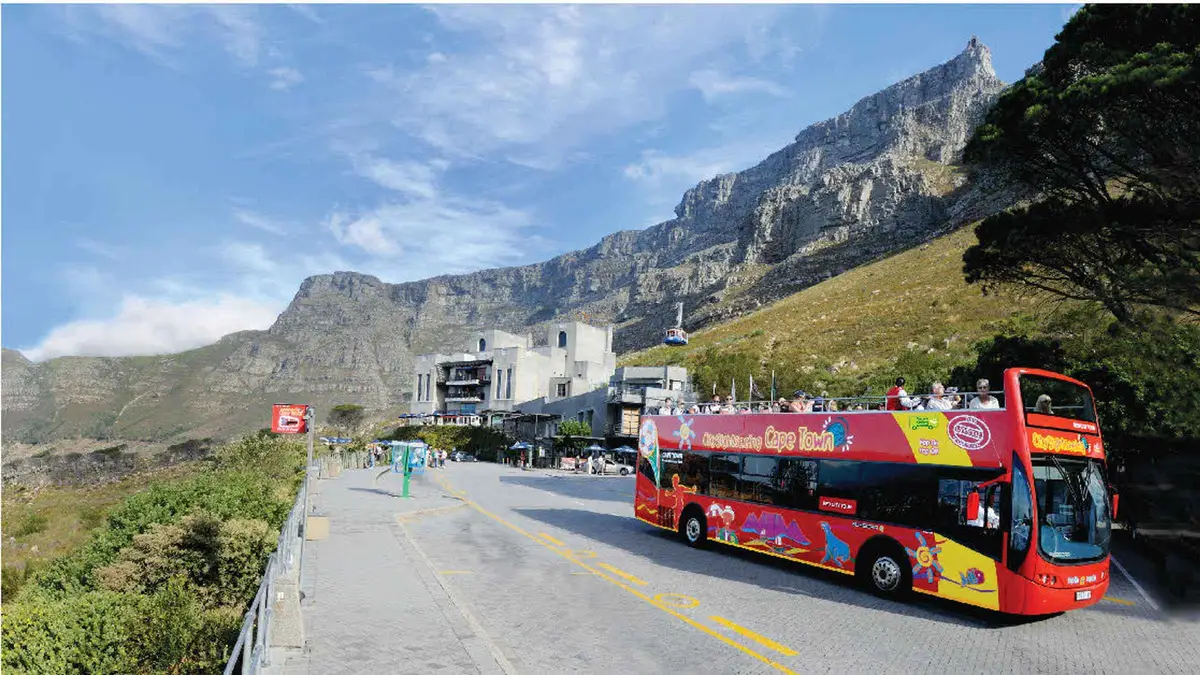 from $33
Cape Town: Hop-On Hop-Off Bus Tour with Optional Cruise
48 hours of open-top bus across the city routes with commentary in 15 languages, onboard Wi-Fi and a free walking tour. It moves you between sights — their entry fees stay separate.
Check AvailabilityPrices, ratings and details are the platform's own, checked in Q3 2026; dollar figures are the listed prices — the platform bills in your account's currency.
Where To Go Next
The rest of the arrival admin
Airport transport, ride-hail and the transit card: the airport-to-city page and getting around Cape Town.
Sort the SIM firstThe budget this page feeds into
Card-first culture, the cash float and what a day runs: Cape Town trip costs.
Tap water = free line itemThe season behind the water story
Winter rain, summer wind and when the dams fill: the best time to visit. Or start at the Cape Town city guide.
Winter-rainfall climatePower, Water & SIMs: Questions
Is there load shedding in Cape Town right now?
As of in Q3 2026, no — Eskom marked 300 consecutive days without national load shedding on 12 March 2026, and this page is re-checked quarterly because the status can move. For live confirmation on any given day, the EskomSePush app or Eskom's own site settles it in seconds — see the app habit.
Does load shedding affect tourists in Cape Town?
Barely, even when stages run: hotels and restaurants equipped themselves with generators, inverters and gas through the crisis years, the big attractions carry backup, and cuts arrive on a published schedule in roughly 2.5-hour blocks. The one real nuisance is dead traffic lights — the impact table goes situation by situation.
Why does Cape Town have less load shedding than the rest of South Africa?
The city owns the 180 MW Steenbras pumped-storage hydro scheme and uses it to shield its electricity customers from up to two stages of national cuts where possible — often meaning no cuts in the city while the country rotates. The buffer section explains it, including why Eskom-supplied suburbs are the exception.
Can you drink the tap water in Cape Town?
Yes — the city states its water is reliable, tested, treated and safe to drink, backed by 99.0–99.6% compliance with the SANS 241 national standard across more than 5,700 samples a year and Platinum Blue Drop certification. Order tap water in restaurants without hesitation. See the water story.
What happened with Day Zero in Cape Town?
In the 2018 drought the city imposed Level 6B restrictions from 1 February 2018 — 50 litres per person per day — as dam levels fell toward a projected shut-off nicknamed Day Zero. The taps never actually closed: demand cuts and returning rains turned it around, and the recovery ended in the certifications above. The table has the arc.
How do I get a SIM card in Cape Town as a tourist?
Any SIM sale requires RICA registration — passport plus proof of your accommodation address — done in minutes at the MTN store in international arrivals or Vodacom's airport stores. A travel eSIM installed before you fly skips the process entirely since you never buy a local SIM. The SIM section weighs the two paths.
What is the EskomSePush app and do I need it?
The unofficial app South Africans use as the national load-shedding dashboard: suburb-level schedules, push alerts before your block, current stage on the front screen. Two minutes to install and set your suburb on arrival — in a calm year it then sits silent, which is exactly the reassurance you want. See the app habit.
The Grid Story, Explained On Camera
Three clips for the curious — the five-minute history, the utility's own explainer, and how the country engineered its way back.
Explained: South Africa's Load Shedding Story in Five Minutes
The fastest honest history of how the crisis built and what a 'stage' actually means.
Video: South Africa: ExplainedEskom: Load Shedding Explained
The utility's own explainer of why rotating cuts protect the grid — the mechanism behind the schedules.
Video: Eskom OfficialHow South Africa Reduced Load Shedding | The Transition Explained
The capacity story behind the calm this page reports — context for the 300-day milestone.
Video: Energy Conversations PodcastVideos load from YouTube only when you press play.
Reviewed Q3 2026 (July–September 2026); next review Q4 2026. Prices, hours and terms are set by the venue or operator and confirmed at checkout.
We may earn a commission if you book through one of our links, at no extra cost to you. Full affiliate disclosure